About the Show
Recent Episodes
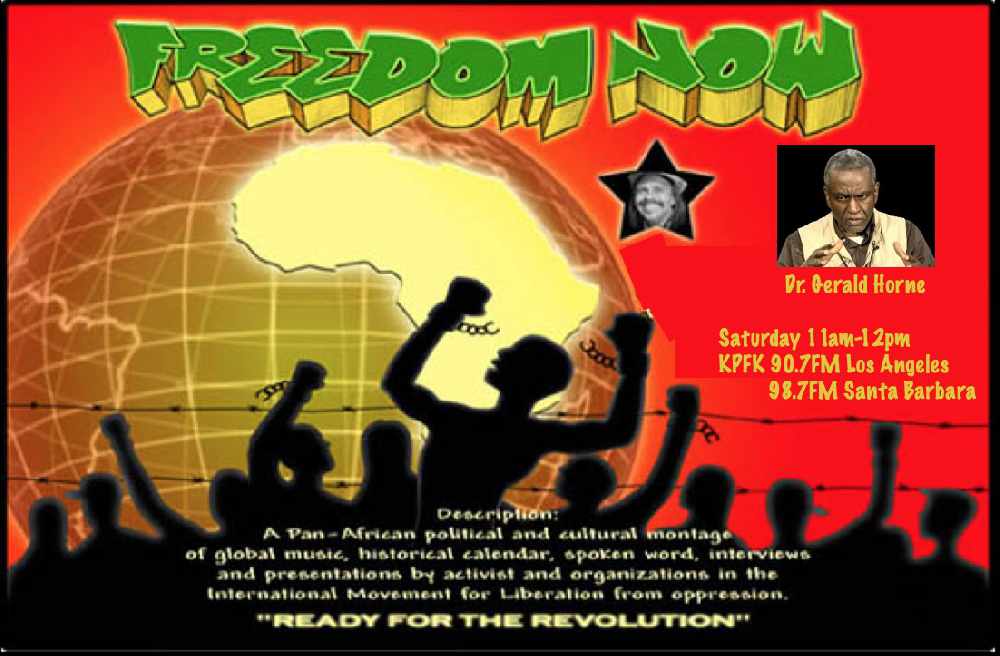
Freedom Now
Sister Tej outlines the program's focus on prisons, psychiatric institutions, colonial repression, and state violence, emphasizing the importance of dignity and self-determination. Br. Gerald Horne interviews Kylie Smith about her book, 'Jim Crow in the Asylum,' which discusses how psychiatric institutions reinforced racial capitalism and state violence. Mumia Abu-Jamal reflects on Steve Biko's legacy and the current struggles in South Africa, highlighting the ongoing issues of land ownership and neoliberalism. A tribute is paid to revolutionary organizer Benise Oliver-Velez, detailing her contributions to community activism and liberation movements.
Freedom Now
Geralb Horn speaks with Ellen McLarney about her book, 'Black Arts, Black Muslims, Islam and the Black Freedom Struggle,' discussing the influence of Islam in the Black Arts Movement. McLarney describes how poets from this movement incorporated Islamic motifs into their work. Horn also interviews Amaya Gelman about the Anti-Defamation League's role in shaping racial politics in the U.S., arguing that it serves to uphold white supremacy while claiming to combat discrimination. Gelman outlines the League's historical connections to anti-communism and its current alignment with right-wing politics.
Freedom Now
Anjali Kiju states that Freedom Now is committed to the principle of self-determination for all peoples. Sister Luyanda Koboka discusses significant historical dates related to slavery, including the founding of the Nation of Islam and Algeria's independence. Patricia Seed argues that the Portuguese played a crucial role in the Atlantic slave trade, linking it to religious justifications. Sean Kim Buterak explains the continuity between slave rebellions and modern prison systems, emphasizing the state's response to resistance. Jeremy D. Popkin outlines the impact of the French Revolution on abolition and the role of Haiti in the struggle for freedom.
Freedom Now - Saturday, June 13, 2026
Brandon Sankara introduces the theme of Black Women's Struggles and thanks listeners for their support. Gerald Horne discusses the historical context of the pelvic exam with Wendy Klein, emphasizing the exploitation of enslaved women in medical practices. Klein argues that understanding this history is crucial for addressing current abuses in gynecology. Horne later speaks with Raelynn Rabaka about her book on Black Feminist Funk, highlighting the contributions of women in funk music and their role in the Black women's liberation movement. Rabaka asserts that figures like LaBelle and Chaka Khan challenged societal norms and expressed sexual freedom through their music.
Freedom Now - Saturday, June 6, 2026
Sister Thade states that today's program focuses on Pacific Nations at the United Nations regarding sovereignty and climate change. Pa'ele Kiokona discusses the Nation of Hawaii's advocacy for sovereignty and the impact of colonialism on Hawaiian lands and resources. Watna Mori explains the recent United Nations resolution affirming the International Court of Justice's advisory opinion on climate obligations. Mori emphasizes the importance of Indigenous perspectives in legal frameworks and the need for accountability in climate justice. The program also features commentary from political prisoner Mumia Abu-Jamal on societal dislocation and resistance.
Freedom Now - Saturday, May 30, 2026
Brother Brandon Sankara describes the theme of Black Exile, introducing segments featuring Mumia Abu-Jamal discussing Frantz Fanon's works. Dr. Gerald Horn is joined by Gregory Vargo, who outlines the life of Ira Aldridge, the first Black British theatrical star, and his contributions to theater and abolitionism. Vargo argues that Aldridge's plays highlight the agency of enslaved people in their own liberation. Horn later speaks with Russell Rickford about his book on Guyana's role in African-American internationalism during the 1970s, emphasizing the complex political landscape of the time.